Showing posts with label News. Show all posts

Monday, 2 May 2011

Who is Osama Bin Laden?

Reference Site: BBC / WIKIPEDIA
March 10, 1957 – May 2, 2011 (aged 54)
Place of birth...........Riyadh, Saudi Arabia
Place of death........Abbottabad, Pakistan
Resting place...............North Arabian Sea
Allegiance...................................Al-Qaeda

Battles/Wars of Terror
Soviet war in Afghanista
Date 27 December 1979 – 15 February 1989 (9 years, 50 days)
War in Afghanistan
Date October 7, 2001 – present - (9 years, 206 days)
War in North-West Pakistan
Date March 16, 2004 – ongoing - (7 years, 47 days)

Osama Bin Laden is both one of the CIA's most wanted men and a hero to many young people in the Arab world. He and his associates were already being sought by the US on charges of international terrorism, including in connection with the 1998 bombing of American embassies in Africa and last year's attack on the USS Cole in Yemen.

In May this year a US jury convicted four men believed to be linked with Bin Laden of plotting the embassy bombings in Kenya and Tanzania.

Bin Laden, an immensely wealthy and private man, has been granted a safe haven by Afghanistan's ruling Taleban movement.

During his time in hiding, he has called for a holy war against the US, and for the killing of Americans and Jews. He is reported to be able to rally around him up to 3,000 fighters.

He is also suspected of helping to set up Islamic training centres to prepare soldiers to fight in Chechnya and other parts of the former Soviet Union.

Sponsored by US and Pakistan
His power is founded on a personal fortune earned by his family's construction business in Saudi Arabia.

Born in Saudi Arabia to a Yemeni family, Bin Laden left Saudi Arabia in 1979 to fight against the Soviet invasion of Afghanistan.

The Afghan jihad was backed with American dollars and had the blessing of the governments of Saudi Arabia and Pakistan.

He received security training from the CIA itself, according to Middle Eastern analyst Hazhir Teimourian.

While in Afghanistan, he founded the Maktab al-Khidimat (MAK), which recruited fighters from around the world and imported equipment to aid the Afghan resistance against the Soviet army.

Egyptians, Lebanese, Turks and others - numbering thousands in Bin Laden's estimate - joined their Afghan Muslim brothers in the struggle against an ideology that spurned religion.

Turned against the US

After the Soviet withdrawal, the "Arab Afghans", as Bin Laden's faction came to be called, turned their fire against the US and its allies in the Middle East.

Bin Laden returned to Saudi Arabia to work in the family construction business, but was expelled in 1991 because of his anti-government activities there.

He spent the next five years in Sudan until US pressure prompted the Sudanese Government to expel him, whereupon Bin Laden returned to Afghanistan.

Terrorism experts say Bin Laden has been using his millions to fund attacks against the US.

The US State Department calls him "one of the most significant sponsors of Islamic extremist activities in the world today".

According to the US, Bin Laden was involved in at least three major attacks - the 1993 World Trade Center bombing, the 1996 killing of 19 US soldiers in Saudi Arabia, and the 1998 bombings in Kenya and Tanzania.

.

Thursday, 17 March 2011

Reactors


Wednesday, 16 March 2011

Japan's nuclear crisis

Timeline: How Japan's nuclear crisis unfolded

     By Bryony Jones, for CNN


(CNN) -- Authorities in Japan are battling to resolve a series of crises at the nuclear power plant at Fukushima Daiichi, which was badly hit by last Friday's devastating earthquake and tsunami. Here's a look at efforts to contain the damage and avert a potential nuclear meltdown. (all times and dates are local).

Friday, March 11
2.46 p.m. (0.46 a.m. ET/5.46 a.m. GMT): A magnitude 9.0 earthquake strikes an area 370 kilometers (230 miles) northeast of Tokyo, Japan, at a depth of 24.5 kilometers.The offshore quake, the fifth largest worldwide since records began, sparks a major tsunami warning across the Pacific. Within an hour a wall of water up to 9 meters (30 feet) high hits the Japanese coast, sweeping away towns and villages in its path. The quake causes serious damage at Tokyo Electric Power Company's (TEPCO) Fukushima Daiichi nuclear power plant, about 65 kilometers south of Sendai. Three of the plant's six reactors, which came into service between 1970 and 1979, were already shut down for inspection at the time the disaster struck. Those still in operation are designed to also shut down in the event of a quake, with diesel generators pumping water around the reactors to keep them cool. But when the tsunami hits, flood water swamps the generators, causing them to fail. The reactors begin to heat up.
8.15 p.m.: The Japanese government declares an emergency at Fukushima Daiichi power plant.
10.30 p.m.: Authorities reveal the cooling system at the plant is not working, and admit they are "bracing for the worst."

Saturday, March 12
2.06 a.m.: Radiation levels in the No.1 reactor at Fukushima are reported to be rising.
3.24 a.m.: Japanese trade minister Banri Kaieda warns that a small radiation leak could occur at the plant.
6.45 a.m.: TEPCO says radioactive substances may have leaked at Fukushima. Japan's Nuclear and Industrial Safety Agency says radiation near the plant's main gate is more than eight times the normal level.
4.19 p.m.: Japan's Nuclear and Industrial Agency reveals a small amount of radioactive cesium has escaped from the power plant, possibly caused by a fuel rod melting.
EXPLOSION: 6.22 p.m.: A hydrogen explosion at Fukushima's reactor No.3 blows the roof off the containment structure around the No.1 reactor and injures four people.
8.18 p.m.: Residents living within 20 kilometers of the plant are told to evacuate the area. Some 200,000 people leave.
8.54 p.m.: Authorities insist no harmful gases were emitted as a result of the explosion at the Fukushima plant, blaming the blast on "water vapor that was part of the cooling process."
10.35 p.m.: Radiation levels around the plant fall as officials prepare to flood the containment structure around the reactor with sea water to cool it. Meanwhile, authorities prepare to distribute iodine tablets to residents near the damaged nuclear plant to prevent radiation poisoning.

Sunday, March 13
3.20 a.m.: Three people randomly selected from a group of 90 test positive for radiation exposure in Fukushima prefecture.
5.37 a.m.: Japanese authorities say Saturday's explosion at the Fukushima Daiichi plant occurred outside the primary containment vessel, adding that the vessel's integrity has not been compromised.
4.46 p.m.: Chief Cabinet Secretary Yukio Endo warns of the possibility that a second explosion could happen at the No.3 reactor.

Monday, March 14
EXPLOSION: 11 a.m.: Hydrogen explosion at the No.3 reactor damages the cooling system at the No.2 reactor and injures 11 people. A wall at the plant collapses as a result of the blast, but officials say the containment vessel surrounding the reactor remains intact. Authorities begin pumping a mixture of sea water and boron into the No.2 reactor to cool its nuclear fuel rods. Those residents living within 20 kilometers of the plant who have so far ignored evacuation orders are warned to stay indoors. Up to 2.7 meters of the No.2 reactor's control rods are left uncovered because the pump which keeps them cool has run low on fuel after being left unattended. It causes them to heat up generating radioactive steam.


Tuesday, March 15
EXPLOSION: 6 a.m.: An "explosive impact" rocks the No.2 reactor -- the third blast at the plant in four days -- and damages its suppression pool.
7 a.m.: The U.S. Navy begins repositioning ships and planes after detecting low-level "airborne radioactivity" in the region. Three people on the U.S.S. Ronald Regan earlier tested positive for low levels of radiation.
8.30 a.m.: Chief Cabinet Secretary Yukio Edano says he cannot rule out the possibility of a meltdown at all three of the plant's damaged reactors. He says radiation levels at the plant have increased to "levels that can impact human health", and warns anyone living within 20 and 30 kilometers of the plant to remain indoors. Almost all of the plant's staff, about 800 people, are evacuated from the site, with just 50 remaining to carry out emergency operations.
FIRE: 8.54 am: Fire breaks out in a cooling pond used for nuclear fuel at the No.4 reactor -- which had been shut down before Friday's quake. Japanese Prime Minister Naoto Kan warns that "there is still a very high risk of further radioactive material coming out," but urges the public to remain calm. The government imposes a no-fly zone within a 30-kilometer radius of the plant.

11 a.m.: The fire in No.4 reactor is reported to have been extinguished. The International Atomic Energy Agency reveals that radiation levels at the plant have been recorded at 167 times the average annual dose of radiation, but that level is expected to drop quickly.
11.10 p.m.: The IAEA reports that Monday's blast at reactor No.2 "may have affected the integrity of its primary containment vessel."
11.45 p.m.: TEPCO says it plans to use helicopters to pour water onto reactor No.4 in order to cool the nuclear fuel rods.

Wednesday, March 16
FIRE: 7 a.m.: The second fire in two days is discovered in the building of the No. 4 reactor at Fukushima Diiachi. This one is in the northeastern corner of the building, an official with Tokyo Electric and Power told reporters.


Saturday, 12 March 2011

Major Earthquake Strikes Japan

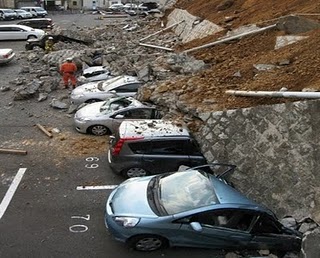
MORE than 1000 people are feared dead and authorities warned a meltdown may be under way at a nuclear plant after a monster tsunami devastated northeast Japan.


Twitter Delicious Facebook Digg Stumbleupon Favorites More